

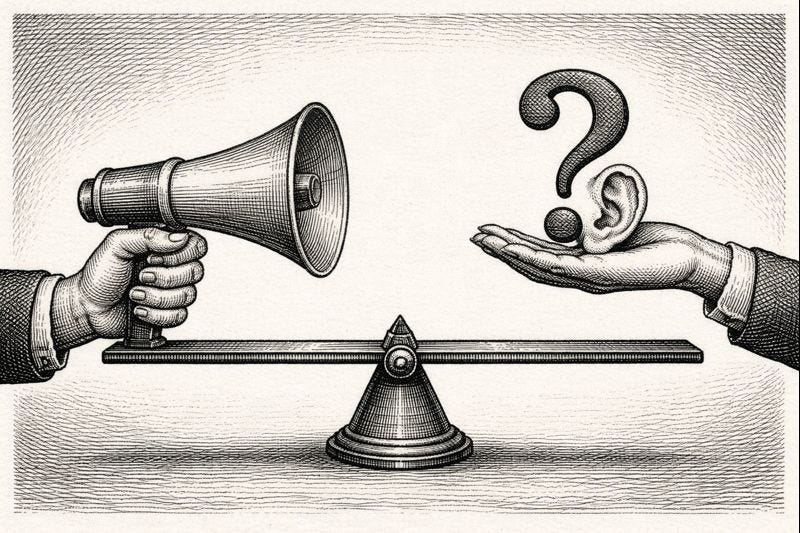
Exploring the Art of Humble Inquiry
In their book, Humble Inquiry: The Gentle Art of Asking Instead of Telling, Ed and Peter Schein note:
As our world too often values expertise over inquiry, we have placed disproportionate value on telling each other things, showing off how much we know, and winning arguments, whether we’re using verified data or not.
When we tell rather than ask, our relationships tend toward what they refer to as “Level 1 (Transactional) or even “Level -1” (Domination). In contrast, the authors write:
If there is one theme that matters most in this book, it is this: moving relationships from transactional to personal [Level 2] is beneficial, even critical, as interdependency and task complexity increase.
They advocate engaging in “Humble Inquiry” as a method to develop more personal relationships based on trust:
Humble Inquiry is the fine art of drawing someone out, of asking questions to which you do not already know the answer, of building relationship based on curiosity and interest in another person.
As I’ve noted elsewhere, I find their entrieties persuasive. But most truths are conditional. So, I’ve been thinking about the conditions under which Humble Inquiry is most appropriate.
Heuristic for Humble Inquiry
The Scheins acknowledge that Humble Inquiry may not be suitable in every situation:
What is tricky about authenticity and sincerity is that neither is entirely up to you.
Positive relationships, by definition, reflect mutuality and reciprocity. Trust can’t be demanded or even earned; it must be granted by another. Consequently, I suspect the indiscriminate use of the Humble Inquiry approach could backfire on occasion, despite our best intentions.
Here’s my initial take on a heuristic for determining how to approach a given situation. The idea is to ask each question in order and act as soon as you reach a clear decision point. The more questions you answer affirmatively, the more you should lean into genuine curiosity rather than telling.
Dependency
“Do I need this person’s cooperation, insight, or buy-in?”
└ No → Default mode (telling is fine)
└ Yes → Continue ↓Expertise Gap
”Does this person hold knowledge or perspective I lack?”
└ No → Light inquiry (ask to confirm, then share)
└ Yes → Continue ↓Power Dynamic
“Could my status or authority trigger defensiveness or compliance?”
└ No → Moderate inquiry (balance asking and telling)
└ Yes → Continue ↓Emotional Stakes
”Are emotions, identity, or trust at risk in this interaction?”
└ No → Moderate inquiry
└ Yes → Continue ↓Novelty/Uncertainty/Complexity
”Is this situation ambiguous, unfamiliar, rapidly changing, or characterized by interdependence?”
└ No → Moderate inquiry
└ Yes → Continue ↓Mutuality
”Does this person seem open to and capable of deeper engagement right now?”
└ No → Moderate inquiry
└ Yes → Humble Inquiry (prioritize asking; minimize telling)
Here’s what I think I mean regarding the response modes:
Default: Share information directly; asking is optional.
Light Inquiry: Ask a confirming question, then proceed with your input.
Moderate Inquiry: Alternate between curious questions and contributing your view.
Humble Inquiry: Lead almost entirely with open questions; suspend judgment; listen first.
Where I’ve Landed (For Now)
My sense is that the fundamental assumptions underpinning Humble Inquiry are correct:
Managing complexity benefits from open communication and collaboration based on trust.
We tend to tell rather than ask, so shifting our mindset to the reverse is more likely to reveal new information and tensions and build more personal relationships.
Even so, both parties have to desire a more personal relationship. I’m wary of using Humble Inquiry naively because it could come across as intrusive, condescending, or manipulative.
The simpler rule of thumb might be:
When you need cooperation, lack expertise, or face complexity, lead with questions rather than statements. Avoid getting too personal, too fast, though.