


My Conundrum
For the last couple of years, my collaborators and I have been exploring a promising new twist on an old technique. Reflect & Engage is an AI-supported facilitation architecture designed for situations where orientation is the primary constraint—complex, ambiguous contexts where the path forward is unclear, and the consequences of a misstep are material. It’s designed to help actualize latent cognitive diversity by engaging team members asynchronously through a series of reflection questions before meeting live.
If you want a good answer, ask a good question.
Therein lies a challenge. What constitutes a good question in these types of situations?
Humble Inquiry
To help me answer my questions about questions, I’ve been learning about Ed and Peter Schein’s Humble Inquiry approach. It teaches that in complex, human systems, the ability to ask sincere, relationship-centered questions is more important than having fast or confident answers. They argue that getting the tone right is crucial to building trust and eliciting candor.
I suspect that may be particularly true when using virtual interview techniques (e.g., text questions and audio answers). Without a full palette of verbal and nonverbal signals, the chances of misreading a question and triggering defensive routines seem likely to increase. Worse, there is no real-time repair loop in such asynchronous exchange. When a question lands wrong, the response is more likely to be defensive, self-censored, or ignored entirely.
On the other hand, we must formulate our questions in advance. That means we can be deliberate and measured. We don’t have to tap dance in real time.
The Humble Inquiry Evaluator
That’s got me thinking about how we might develop a tool to help us iterate and improve our questions evaluated through the Humble Inquiry lens. My initial effort is the “Humble Inquiry Evaluator” application.
A Plausible Scenario
Consider the following scenario:
MidTech Manufacturing is a 350-employee company that produces specialized industrial components. They’ve been successful with traditional operations but are facing increasing pressure from competitors who have modernized their systems. The leadership team has decided to pursue a comprehensive digital transformation, including cloud migration, new ERP implementation, and automation of key processes.
The CEO has called for a strategic planning retreat to determine the digital transformation roadmap and priorities. She suspects, however, that there are significant tensions and misalignment across departments. Her suspicions are warranted:
The IT Director wants to migrate everything to the cloud for scalability and believes that other departments don’t understand technical complexity.
The Operations Manager fears production disruptions during transition and assumes IT will prioritize flashy features over operational stability.
The Sales Director needs CRM integration and mobile access for her team, but she believes current systems are good enough and that changes will hurt customer relationships.
The CFO is concerned about ROI and implementation costs and suspects other departments are pushing expensive solutions without clear business cases.
The HR Director is concerned about employee training and change management and believes technical teams underestimate the human impact of system changes.
What kinds of questions might be asked in advance to effectively surface these concerns and assumptions, so they can be addressed constructively during the retreat?
A Candidate Question
Here’s a seemingly reasonable question to ask:
Since everyone agrees we need to modernize, what’s your biggest implementation concern?
Let’s submit it to the evaluator to see what we learn:
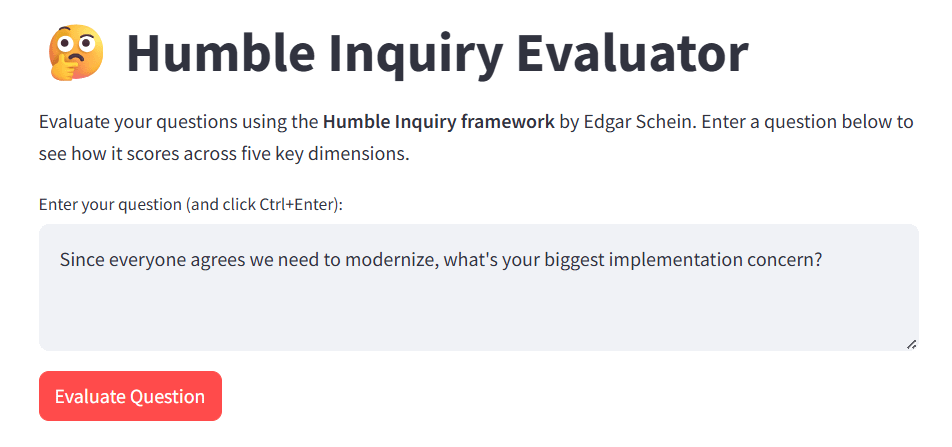
The app evaluates the question across five dimensions on a scale of 0-4 and then sums the results to return an overall score as a rough indication of how well the question follows the Humble Inquiry framework:
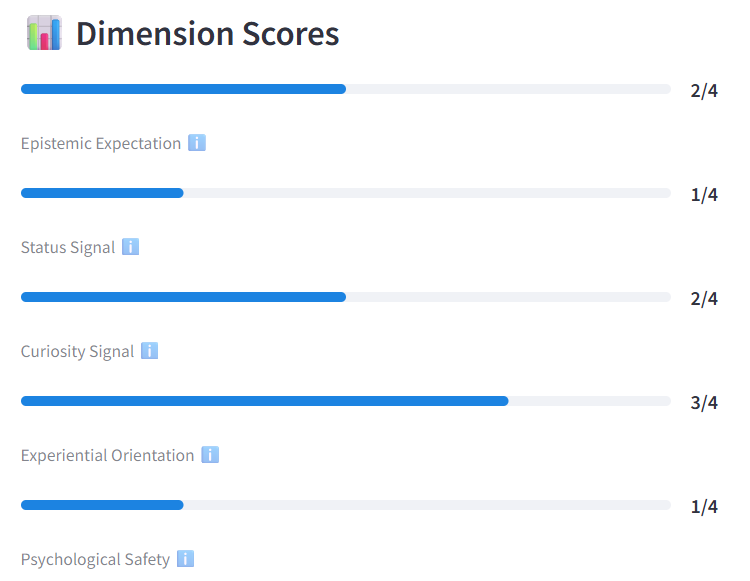
Epistemic Expectation is the degree to which the question expresses genuine not-knowing rather than assuming the answer.
Status Signal indicates the degree to which the question minimizes status distance and signals equality.
A higher Curiosity Signal score indicates strong, authentic interest in learning.
Experiential Orientation indicates the degree to which the question is anchored in concrete experience rather than abstraction, theory, or speculation.
Psychological Safety invites an honest response without fear of judgment.
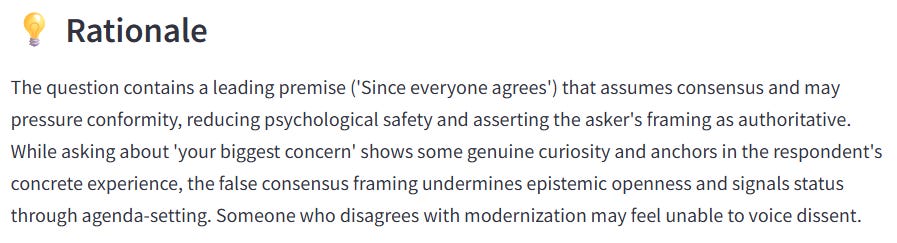
Given an overall score of 9/20, there is clearly room for improvement:
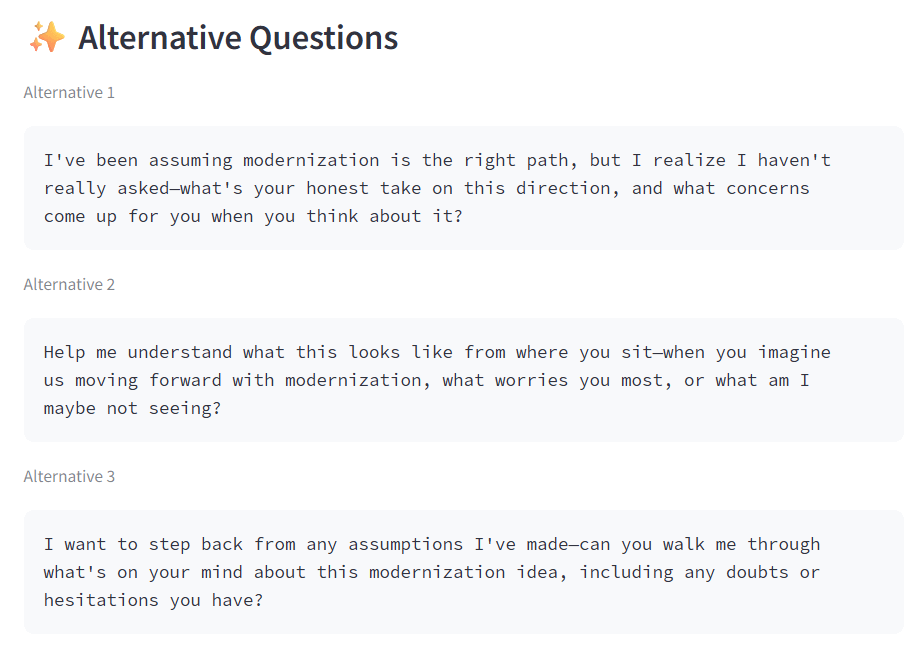
Helpfully, the application suggests some alternative formulations to achieve the question’s objective in a more constructive way:
Initial Impressions
I’m intrigued by both the Humble Inquiry framework and our question evaluation application. I can imagine how the reformulated question—particularly in the context of a virtual interview that reduces time and social pressure—might help uncover tensions earlier and accelerate our fictitious team’s effective orientation. Nevertheless, the litmus test is real world application.
Good against remotes is one thing. Good against the living, that’s something else.
—Han Solo
Nice! Can I try the app?