

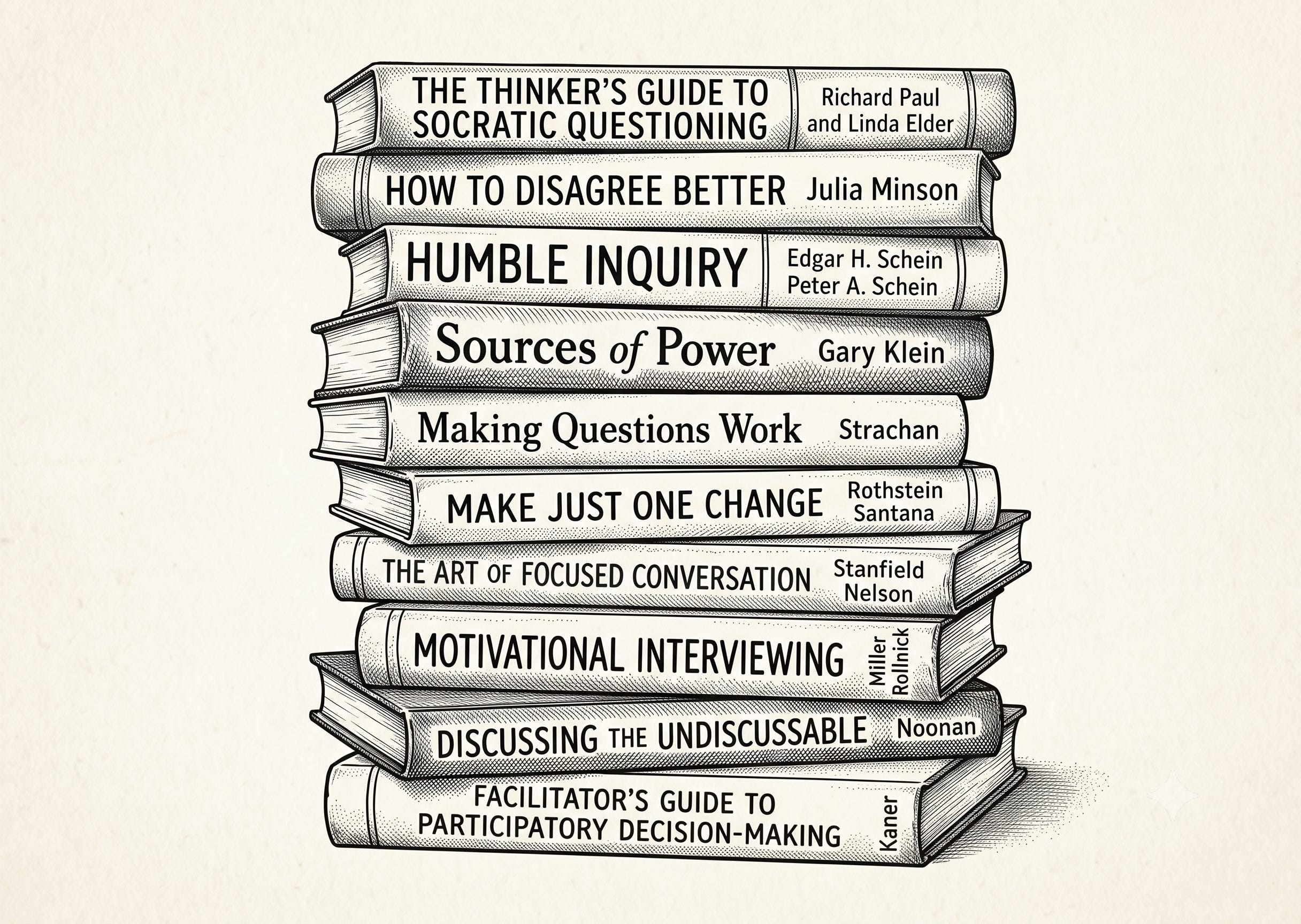
I’m interested in helping to reveal hidden information so that group decisions about complex problems can benefit from cognitive diversity. That requires asking good questions and careful listening.
Easier said than done. Trusted methods give opposing prescriptions for the same moment.
Someone just told you something that matters, and you want to make sure you understood. The Listening Triangle says to play it back in your own words. If you got it slightly wrong, they’ll correct you, and the correction is the most useful thing they’ll say.1 Clean Language says the reverse. Reflect back, but only using the speaker’s own words, because the instant you translate their experience into your phrasing, you’ve overwritten it with yours.2 One method treats your paraphrase as the point. The other treats it as contamination.
My initial instinct was to try to decide which was right. That was mistaken.
The Clue Is in the Contradiction
The Listening Triangle and Clean Language are precise. They genuinely conflict. That means they can’t both be answers to the same question. When two such careful methods give opposing instructions, we shouldn’t ask which is better. We should ask what each method was created to accomplish.
David Grove created Clean Language in the 1980s while working with trauma survivors. Grove systematically analyzed transcripts of celebrated therapists, including Virginia Satir and Carl Rogers, and found that even the best therapists continually shifted their clients’ frames of reference by subtly rewording what their clients said.3 By doing so, they were, however unintentionally, introducing their own model of the world into the therapeutic conversation. Grove advocated using nothing but the speaker’s words and metaphors to protect the speaker’s own model of their experience, which is fragile, half-formed, and easily distorted in that context.
The Listening Triangle shows up in coaching, mediation, and negotiation. It solves a different problem: making sure you, the listener, actually understand the other person’s position correctly, especially when the conversation is heated. The paraphrase isn’t there to honor the speaker’s words; it's there to test the listener’s mental model against the speaker’s perceived reality.
The list of careful methods with different prescriptive behaviors doesn’t end with these two. Edgar Schein, for example, developed Humble Inquiry for an entirely different purpose. He was interested in how information moves, or fails to move, when people are interdependent, and status keeps them quiet.4 His case studies involved catastrophes or near-misses in which someone lower in the hierarchy knew what would have helped but never said it. Schein’s focus is on the interpersonal relationships that make candor possible. Humble Inquiry is about lowering one’s own status enough to make the truth feel less dangerous. It might be more of an attitude than a questioning technique.
So these three methods illuminate three different things. Clean Language helps clarify the speaker’s mental model. The Listening Triangle enhances the listener’s understanding of a situation. Humble Inquiry spotlights the relationship between the speaker and listener. In a real sense, each forbids what the other requires. Each is correct because none of them is trying to do the same thing.
Where the Light Is
A while back, I wrote about how every method is like a streetlight. That is, it illuminates some patch of ground beautifully and leaves everything else dark. The danger is mistaking the lit patch for the whole street.5 The three methods above are subtle examples of this truth. That’s because they’re all about listening, which makes it tempting to grab whichever one you’re most fluent in and treat it as suitable for listening in general.
That’s the Procrustean error.6 Use Clean Language when the real problem is status differences, and you’ll fail to surface a divergent perspective the speaker deems too risky to share. Reach for Humble Inquiry’s warmth when the actual issue is that you misheard what the speaker said, and you’ll build a lovely relationship based on a misunderstanding. Run the Listening Triangle’s paraphrase on someone whose insight is still forming, and you’ll snap it into your framing before it is ready — exactly the failure mode Grove designed Clean Language to prevent. Each method, used on the wrong problem, does the wrong job “well,” which may be worse than doing it badly, because it feels like success.
This is part of the design of Reflect & Engage that I find myself wrestling with. Building a process that “listens” to a group forces the question, “Which listening problem are we solving?” The reflection interview we’ve built is good at addressing exactly one such problem: recording at least one undistorted signal before the meeting, so that what only one person knows doesn’t stay stuck in their head.7 The reflection interview is bad at solving other listening problems. It does not test whether that signal survives contact with a skeptic, and it can’t read the relationship, because there’s no one in the room. These aren’t bugs to patch. They’re the dark outside of our particular streetlight.
The Problem the Methods Don’t Solve
Sorting the methods by purpose is satisfying, and I think it’s right. However, it assumes you can tell which problem you’re facing. Real conversations can include multitudes. The same five minutes can contain a person reaching for a half-formed thought, a status gap keeping them careful about what they say, and a genuine misunderstanding on my part, all at once. The different methods don’t just illuminate different things; they can also interfere with each other. The restraint of Clean Language can be perceived as coldness when warmth was needed. The warmth of Humble Inquiry can feel like evasion when the speaker wants confirmation that they have been precisely understood.
Each method assumes the diagnosis is complete and tells us what to do next. The skill I need most is diagnosing the problem before I reach for a method. I started with asking, “How do I listen well?” That turns out to be inadequate. I need to ask, “What am I trying to find out?” I suspect that learning to answer that question well comes from repeatedly reaching for the wrong light and watching the thing you wanted disappear into the darkness.
I learned about the Listening Triangle from reading Julia Minson’s book, “How to Disagree Better,” which credits Moshe Cohen, who developed the framework in the early 2000s as a tool for mediators and negotiators. His original article can be found here. Daniel Stillman popularized a version oriented toward coaching. His description of the method can be found here. The general pattern of the Listening Triangle is to ask a question, listen to the answer, and acknowledge and reflect.
David Grove developed Clean Language while working with trauma cases as a therapist. James Lawley and Penny Tompkins later systematized it as Symbolic Modeling and transplanted it into coaching. The defining rule is that the facilitator works only with the speaker’s own words and a fixed set of low-assumption questions. Grove’s aim was for the therapist’s presence to all but vanish.
Carl Rogers was a psychologist and one of the founders of humanistic psychology. Virginia Satir was a social worker and psychotherapist known as the “Mother of Family Therapy.”
Edgar Schein, Humble Inquiry: The Gentle Art of Asking Instead of Telling (2013). His central observation is that the art of asking gets harder as one’s status rises, because our culture rewards telling.
The “hidden profile” is the well-documented tendency of groups to discuss what everyone already shares and leave each member’s unique information unspoken. Getting that unshared signal into the “Arena” is the specific job of the reflection interview, not the more general and self-flattering claim of “listening better.”