

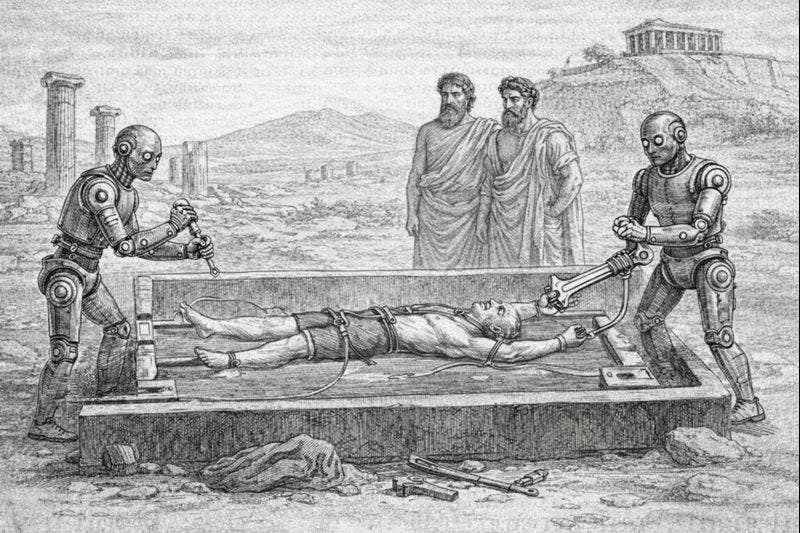
Procrustes’ Bed
In Greek mythology, Procrustes offered hospitality to travelers, but insisted they fit his iron bed perfectly. If they were too short, he would stretch them. If they were too tall, he would amputate the excess.
This ancient tale of forced conformity finds new relevance in Nassim Taleb’s The Bed of Procrustes: Philosophical and Practical Aphorisms, in which he exposes the limitations of human knowledge and eviscerates those who indiscriminately impose their models, methods, and technologies on reality.
I worry about building a Procrustean bed.
The Temptation to Generalize the Particular
Abraham Maslow noted, “I suppose it is tempting, if the only tool you have is a hammer, to treat everything as if it were a nail.” My “hammer” is an AI-assisted facilitation architecture called “Reflect & Engage.”
Ours is a modern take on a tried-and-true technique: If you want to know what people are thinking, ask them. The evolution combines asynchronous reflection capture with AI-assisted orientation. The resulting situational awareness improves the quality of subsequent conversations, ultimately increasing the likelihood of making a good decision.
The approach is undeniably cool. In my enthusiasm, I see lots of applications. After all, orientation—developing situational awareness—is an essential prerequisite to good decision-making in complex situations.
In some of our experiments, enthusiasm was warranted. The process uncovered new information or yielded challenges to key assumptions. In other cases, though, the intervention yielded little insight, felt unnecessarily complex, and veered toward facilitation theater.
These mixed results make me wonder, “Under what circumstances is Reflect & Engage the most useful? When is the juice worth the squeeze?”
After all, complexity has a cost. At a minimum, it demands behavioral changes requiring training, time, and attention. More bluntly, nobody is saying, “What I really need is one more app, one more form, one more task, or one more process.”
Furthermore, technological interventions can have unexpected and unwelcome effects. Sometimes, for instance, we are too confident in the output from an apparently sophisticated system. Contrary to our intent, misapplication of the method might lead to premature convergence and to the omission of important outliers.
First, do no harm. Don’t create a Procrustean bed. Taleb’s “via negativa” principle provides a framework for putting “first, do no harm” into practice.
Via Negativa
Taleb observes that we often understand what is wrong more clearly than what is right. The principle suggests that knowledge and progress can be achieved more effectively by identifying and avoiding the negative. Via negativa (“the negative way”) is characterized by:
Focus on elimination instead of adding more features, solutions, or interventions to help us target the root causes of problems.
Avoid debilitating downside as an essential prerequisite to achieving upside.
Seek simplicity and clarity.
I suspect Taleb would hate Reflect & Engage—unless it were to be applied only where a simpler approach wasn’t feasible, and if the objectives were to:
Uncover hidden information to help convert unknown unknowns into known unknowns.
Highlight minority perspectives to keep options open and avoid premature convergence.
Nevertheless, he would likely be suspicious of “interventionista” tendencies to apply sophisticated tools when simpler structures and approaches might suffice.
When NOT to Use Reflect & Engage
Per via negativa, the most effective way to determine when Reflect & Engage might add value is to first eliminate cases where it's very unlikely to do so. If the following hold true, then Reflect & Engage may not fit:
The group lacks basic psychological safety. Even with the promise of confidentiality, environments that make dissenting views risky are more likely to lead to self-censorship.
Time pressure dominates. Honest reflection and conversation about controversial topics aren’t consistent with tight timelines. Crisis situations demand immediate action.
The group is genuinely homogeneous. The real point of Reflect & Engage is to surface differences. If none exist, the process devolves to facilitation theater.
The “common knowledge” effect is minimal. There is no need for additional complexity if previous discussions have already surfaced dissenting views and tensions.
Authority structures make consensus irrelevant. Reflect & Engage contributes to an orientation that ultimately results in group consensus on a decision. However, if the consensus merely advises, the delay and complexity of the additional process may not be warranted.
Technology comfort is low. In the case of virtual interviews (e.g., text questions and audio responses delivered online), discomfort with technology may be a disqualifier.
Simpler approaches haven’t been tried. Before jumping to a complex solution, rule out simpler approaches.
The facilitator or sponsor lacks “skin in the game.” If the person promoting the use of Reflect & Engage doesn’t have a stake in the outcome of the conversation, the effectiveness of the process may be undermined.
In short, if we ask, “What would happen if we did nothing or used the simplest possible approach,” and the answer is, “We’d get much of the value with less effort,” then Reflect & Engage doesn’t apply. It may apply when we can honestly say:
Minority perspectives likely exist but may be suppressed.
The cost of mis-orientation exceeds the cost of potential delay caused by the process.
Simpler approaches have been tried and found insufficient.
The group represents cognitive diversity and the psychological safety to surface it.
Technology enhances rather than impedes authentic reflection.
I Don’t Want to be a Charlatan
Our egos and wallets encourage us to generalize the particular. However, most truths are conditional. What works in one situation may fail—or cause harm—in an adjacent situation. We risk being revealed as charlatans if we pitch our ideas, frameworks, methods, and models indiscriminately.
I’d prefer not to be a charlatan or compromise the reputations of my collaborators. So, I’m thinking about refining our positioning of Reflect & Engage.
First of all, in the context of orientation, I suspect our focus should be on helping groups avoid bad decisions. In other words, rather than promising good decisions, Reflect & Engage can help groups discover what they don’t know they don’t know—surfacing hidden risks and minority perspectives that could prevent costly mistakes. I think the goal is to make important tensions explicit so they can be addressed in live conversations.
Reconsidering my earlier characterization, I don’t think Reflect & Engage is like a hammer. After all, a hammer can be used in a pretty broad range of circumstances. Instead, I suspect Reflect & Engage is more like a micrometer caliper—most people don’t need thousandths-of-an-inch precision, but when you do, nothing else will suffice.
The question isn’t whether Reflect & Engage is a good methodology. It’s whether I have the discipline to recommend it only when simpler tools won’t suffice. That’s the real test of avoiding Procrustean thinking.